
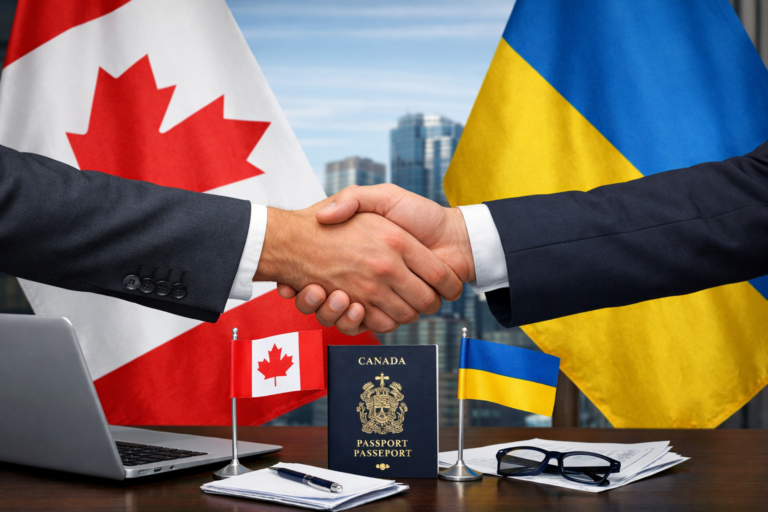
The Canada–Ukraine Free Trade Agreement (CUFTA) creates important immigration opportunities for Ukrainian professionals and businesses seeking to work in Canada. Under this agreement, certain Ukrainian nationals may qualify for LMIA-exempt work permits through Canada’s International Mobility Program (IMP). These permits are issued under Immigration and Refugee Protection Regulations R204(a) (codes F70 to F74) and allow eligible professionals, investors, and intra-company transferees to work in Canada without requiring a Labour Market Impact Assessment.
The CUFTA work permit categories are designed to facilitate cross-border trade, investment, and professional mobility between Canada and Ukraine. This guide explains who qualifies, how the application process works, and what documents may be required when applying for a CUFTA work permit.
If you need guidance on CUFTA work permits or other Canadian immigration matters, the experienced lawyers at Venko Law Firm provide strategic, personalized legal support for workers, employers, and applicants navigating Canada’s immigration system.
Throughout this guide, we reference official guidance from Immigration, Refugees and Citizenship Canada (IRCC). Immigration rules, processing times, and government requirements may change, so obtaining professional legal advice can help ensure that an application is prepared correctly.
What Is CUFTA Under the International Mobility Program?
CUFTA is a bilateral trade agreement that includes temporary entry provisions. Under IRPR R204(a), Canada may issue LMIA-exempt work permits when entry supports a trade agreement. For CUFTA, these exemptions are coded F70–F74 and apply to specific worker categories.
Why CUFTA Matters
- No LMIA required, reducing time and cost.
- Clear eligibility categories for business mobility.
- Supports Canadian employers with specialized skills.
- Provides lawful work authorization pathways for Ukrainian nationals.
CUFTA Work Permit Categories (R204(a): F70–F74)
1. Professionals (F70)
Eligible Ukrainian nationals in approved professions (e.g., engineers, IT specialists, management consultants) may qualify.
- Requires post-secondary credentials and relevant experience.
- Position must align with the listed profession.
2. Intra-Company Transferees – Executives & Managers (F71)
For employees transferred from a Ukrainian enterprise to a Canadian parent, branch, subsidiary, or affiliate.
- Prior employment with the foreign entity is required.
- Role must be executive or managerial.
3. Intra-Company Transferees – Specialized Knowledge (F72)
For workers with advanced proprietary knowledge essential to the Canadian operation.
- Higher evidentiary threshold than executives/managers.
4. Investors (F73)
For Ukrainian nationals making a substantial investment in a Canadian business.
- Must demonstrate active management or control.
5. Business Visitors for Investment Purposes (F74)
Short-term entry for activities related to investment or trade.
- No Canadian labour market entry; limited hands-on work.
Eligibility Requirements at a Glance
| Requirement | Details |
| Citizenship | Ukrainian |
| Job Offer | Required for most categories |
| LMIA | Not required |
| Employer Portal | Offer of employment submission + fee |
| Compliance | Employer must meet IMP compliance rules |
Step-by-Step: How to Apply for a CUFTA Work Permit
- Confirm Category & Eligibility
Identify the correct CUFTA code (F70–F74) and ensure duties match the category. - Employer Submits Offer
Canadian employer files the offer via IRCC’s Employer Portal and pays the compliance fee. - Prepare Documentation
Passport, credentials, experience letters, corporate relationship documents (if applicable). - Submit Work Permit Application
Apply online (inside or outside Canada, as applicable). - Biometrics & Final Decision
Provide biometrics if required and await IRCC’s decision.
Practical Tips & Recent IRCC Considerations
- Accuracy matters: Misclassifying the CUFTA category is a common refusal reason.
- Corporate proof: Intra-company transfers require robust evidence of the qualifying relationship.
- Changing rules: Processing times and document checklists may change—verify before filing.
Frequently Asked Questions (FAQs)
No. CUFTA work permits are LMIA-exempt under R204(a) when eligibility criteria are met.
IRCC reference: https://www.canada.ca/en/immigration-refugees-citizenship.html
Yes, depending on your status and category. Some applicants may apply at a port of entry if eligible.
Validity depends on the category and role, often up to three years, with extensions possible.
In many cases, spouses may qualify for open work permits, and children may study in Canada.
Not directly, but Canadian work experience may support PR pathways. Explore options with a permanent residency lawyer in Ottawa: https://venkolaw.ca/permanent-residence/
Why Choose Venko Law Firm?
Venko Law Firm is a respected Canadian immigration law firm based in Ottawa. Our team provides strategic legal guidance on a wide range of immigration matters, including work permits, study permits, permanent residence applications, family sponsorship, refugee protection claims, and humanitarian & compassionate applications. We focus on delivering clear advice, careful preparation, and personalized support to help clients navigate Canada’s immigration system successfully.
Learn more about our Ottawa immigration lawyer and explore our family sponsorship lawyer in Ottawa services.
Not sure which CUFTA category applies to you or your employee?
Book your first free assessment call with our experienced team at Venko Law Firm