
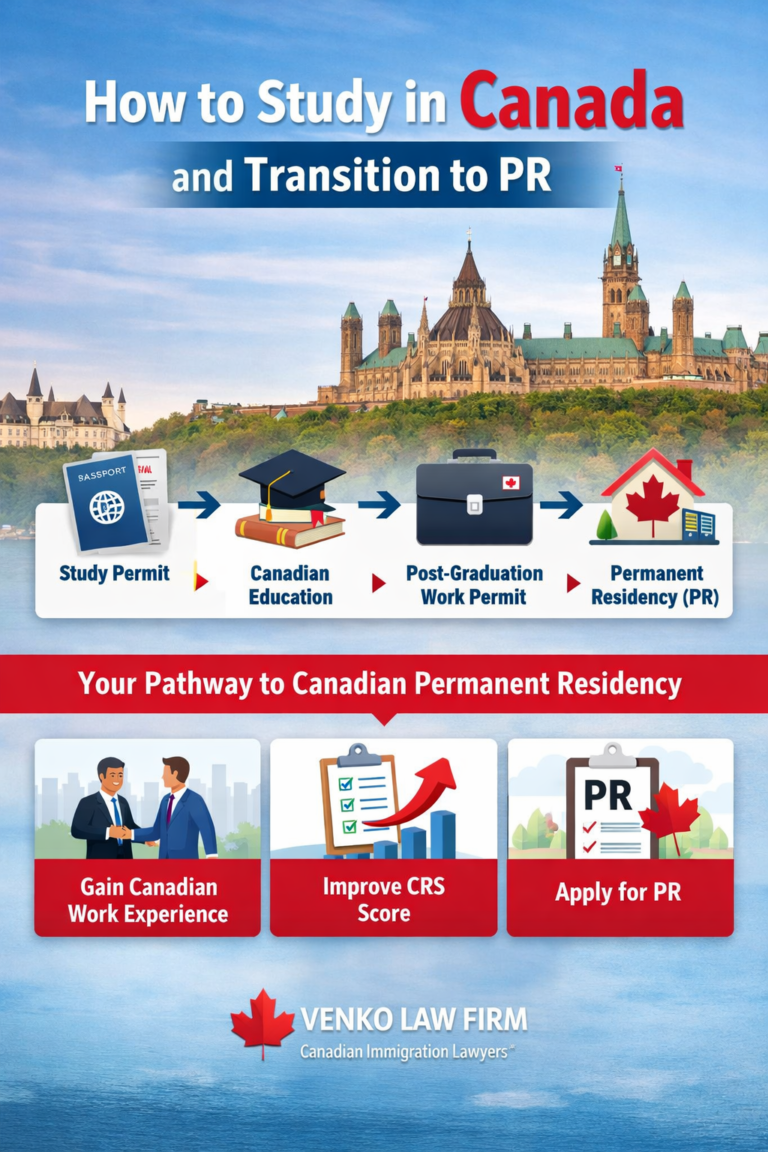
Many international students want to understand how to study in Canada and transition to permanent residence (PR) through a lawful and reliable pathway. Canada remains one of the most attractive destinations for international education because it offers clear opportunities for students to gain Canadian work experience and apply for PR after graduation.
In most cases, the pathway follows a structured process: study permit → Canadian education → post-graduation work permit (PGWP) → permanent residence. To begin this journey, international students must be accepted by a Designated Learning Institution (DLI) and, for many new applicants, must also include a Provincial Attestation Letter (PAL) as required by Immigration, Refugees and Citizenship Canada (IRCC).
This article explains how to study in Canada and transition to PR, including eligibility requirements, PAL rules, work permits, and permanent residence pathways. For personalized advice, consulting an experienced immigration lawyer in Ottawa can help reduce refusals and delays.
👉 Learn more about our services at Venko Law Firm.
Step-by-Step Guide: How to Study in Canada and Transition to PR
Step 1: Acceptance from a Designated Learning Institution (DLI)
To apply for a Canadian study permit, IRCC requires international students to be accepted by a Designated Learning Institution (DLI).
Important clarifications:
- Public universities are DLIs
- Public colleges are DLIs
- Some private institutions are not DLIs
Although universities may not always state “DLI” in their offer letters, they must appear on IRCC’s official DLI list for a study permit to be issued.
📌 IRCC reference:
https://www.canada.ca/en/immigration-refugees-citizenship/services/study-canada/study-permit/designated-learning-institutions.html
Choosing the right institution and program is critical, as it can affect study permit approval, PGWP eligibility, and future PR options.
Step 2: Provincial Attestation Letter (PAL) Requirement (IRCC Policy)
As part of Canada’s international student intake cap introduced in 2024, many new study permit applicants must include a Provincial Attestation Letter (PAL).
What is a Provincial Attestation Letter (PAL)?
A PAL is a document issued by a province or territory confirming that an international student has been allocated a study permit spot under that province’s quota.
Critical clarification (IRCC-verified):
PAL requirements are not based on whether a student is attending a college or a university.
Instead, PAL requirements depend on:
- Whether the application is a new study permit
- The level and type of program
- Whether the applicant qualifies for an IRCC-listed exemption
PAL is generally required for:
- Undergraduate university degree programs
- Undergraduate college programs
- Graduate certificates and diplomas (including those offered by universities)
- Most new study permit applications from outside Canada
PAL is generally NOT required for:
- Study permit extensions at the same institution and same level
- Primary or secondary school studies
- Certain master’s and PhD degree programs (policy-based exemptions)
- Exchange students
- Applicants covered by specific IRCC public policy exemptions
⚠️ Important:
If a PAL is required and not included at the time of application, IRCC may return the study permit application without processing.
📌 IRCC reference:
https://www.canada.ca/en/immigration-refugees-citizenship/services/study-canada/study-permit/get-documents/provincial-attestation-letter.html
Because exemptions are limited and fact-specific, legal review before submission is strongly recommended.
Step 3: Apply for a Canadian Study Permit
Once you have:
- A Letter of Acceptance from a DLI, and
- A PAL (if required)
You may submit your study permit application to IRCC.
Applicants must demonstrate:
- Sufficient financial support (tuition and living expenses)
- Genuine intent to study
- Compliance with medical and security requirements
- Clear academic and future plans
Immigration rules and processing times may change. Always verify requirements with IRCC or consult a licensed immigration lawyer.
Step 4: Work While Studying in Canada
Most international students are allowed to work:
- Up to 20 hours per week off-campus
- Full-time during scheduled academic breaks
Authorized work experience helps students integrate into the Canadian labour market and strengthens future PR eligibility.
Step 5: Post-Graduation Work Permit (PGWP)
Graduates of PGWP-eligible programs at eligible DLIs may apply for a Post-Graduation Work Permit (PGWP).
PGWP highlights (IRCC-verified):
- Valid for up to 3 years
- Open work permit (no employer restrictions)
- Allows graduates to gain skilled Canadian work experience
The PGWP is often the key bridge in the process of how to study in Canada and transition to PR.
Permanent Residence Pathways After Studying in Canada
Express Entry – Canadian Experience Class (CEC)
International graduates may qualify for PR through Express Entry if they have:
- At least one year of skilled Canadian work experience
- Valid language test results
- Legal status in Canada
👉 Speak with a permanent residency lawyer in Ottawa to assess eligibility.
Provincial Nominee Programs (PNPs)
Many provinces offer international graduate streams, often with:
- Lower CRS score requirements
- Employer-driven pathways
- Faster PR processing in some cases
Family or Spousal Sponsorship
Graduates with a Canadian spouse or partner may qualify for PR through sponsorship.
👉 Learn more from a family sponsorship lawyer in Ottawa.
Eligibility Overview: Study to PR Pathway
| Requirement | IRCC Criteria |
| Institution | DLI-approved university or college |
| PAL | Required for many new applicants |
| Study Permit | Valid throughout studies |
| PGWP | Program and institution eligible |
| Work Experience | 1 year skilled (CEC) |
| Legal Status | Maintained at all times |
Unsure whether your program requires a PAL or qualifies for a PGWP?
📞 Book your first free assessment call with an experienced immigration lawyer in Ottawa at Venko Law Firm.
Frequently Asked Questions (FAQ)
No. IRCC does not limit PAL requirements to colleges. PAL requirements apply based on the type of application and program, not whether the institution is a college or a university.
Many undergraduate university students and some graduate applicants do require a PAL, unless they qualify for a specific IRCC exemption.
Most students transition within 2–4 years, depending on work experience, language scores, and the PR program used.
Yes. Many graduates apply for PR while legally working in Canada on a PGWP.